


Thông báo

CẢM ƠN QUÝ KHÁCH ĐÃ ĐẶT LỊCH KHÁM TẠI AIH.
Quý khách có muốn đăng ký thông tin trước không?
Vui lòng điền vào thông tin bên dưới
Khẩn cấp
URINARY INCONTINENCE IN MEN & WOMEN: COMMON CAUSES AND TREATMENT MEASURES

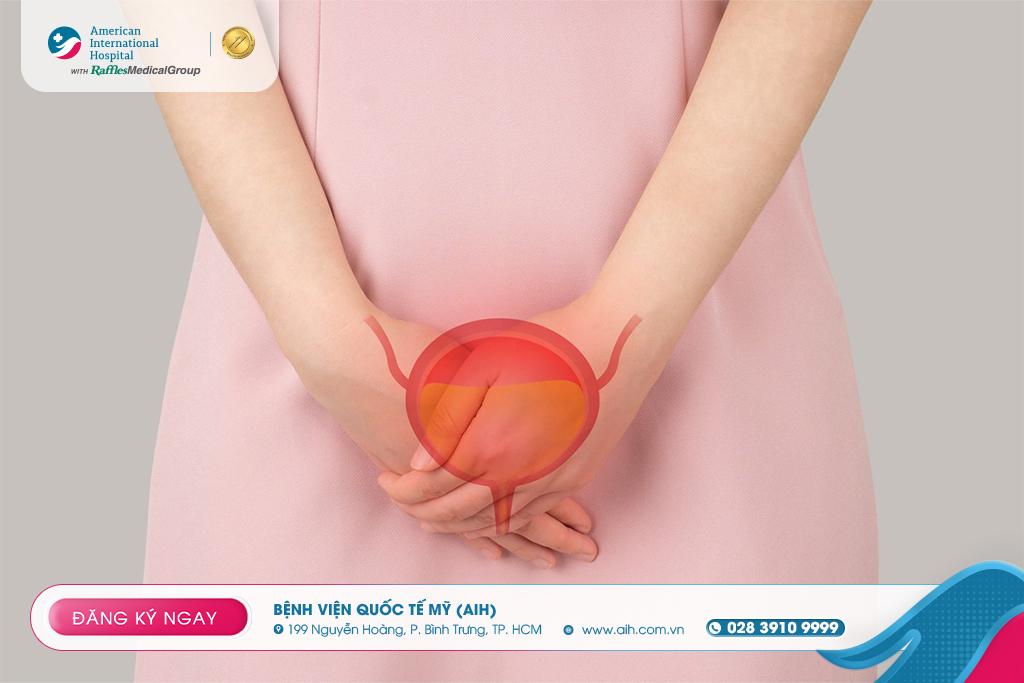
Urinary incontinence is the loss or impairment of bladder control, leading to unintentional leakage of urine. This is a manifestation of lower urinary tract dysfunction in storing/emptying urine, which can be caused by abnormalities in the bladder, urethra – sphincter, pelvic floor, or neurological regulation. The consequence often is restricted activities, affecting quality of life.
Classification
Stress urinary incontinence: Leakage occurs when there is increased intra-abdominal pressure, such as during coughing, sneezing, laughing, or physical activity.
Urinary urgency – Overactive bladder: Characterized by a sudden, compelling urge to urinate that is difficult to defer, immediately followed by leakage.
Overflow incontinence: The bladder does not empty completely, leading to continuous leakage or dribbling of urine.
Urinary incontinence due to physical or cognitive limitations.
Mixed incontinence: A combination of two or more mechanisms of disorder, most commonly are stress urinary incontinence and urinary urgency due to overactive bladder.
Causes
In women: causes related to weakening of the urethral-pelvic floor support structures after childbirth, aging; decreased estrogen after menopause makes the urethral-bladder lining easily irritable. Habits/dietary factors that "stimulate the bladder" (caffeine, alcohol, carbonated drinks, high-dose vitamin C) and urinary tract infections can exacerbate symptoms.
In men: causes include benign prostatic hyperplasia leading to lower urinary tract obstruction; urinary disorders after prostate cancer treatment (especially after surgery/radiation) can cause urinary incontinence due to mechanical and neurological mechanisms.
Neurogenic causes (neurogenic bladder): spinal cord injury, central/peripheral neuropathy that disrupt the interaction between the brain – spinal cord – bladder – sphincter.
Symptoms
Typical manifestations include leakage during exertion; sudden urge to urinate, frequent urination/day, nocturia; weak, intermittent, prolonged dribbling stream; feeling of incomplete bladder emptying; sometimes painful urination if accompanied by infection. Symptom characteristics help determine the type of illness and choose appropriate investigations.
Diagnosis
History taking – examination: symptom classification, onset factors; stress test (cough) to reveal leakage. Encourage a voiding diary (number of urinations, amount of leakage, fluid intake) to characterize the type of disorder.
Basic tests: urinalysis to rule out urinary tract infection; ultrasound/post-void residual (PVR) measurement if retention is suspected.
Thorough investigation: urodynamics assesses pressure-flow, bladder storage/emptying capacity – sphincter; indicated when diagnosis is unclear, symptoms are complex, or before intervention.
Treatment
The principle is to personalize treatment according to the disease type, severity, and comorbidities, usually progressing in a stepwise manner from conservative to invasive.
1) Behavioral – lifestyle measures
Adjust fluid intake, avoid bladder irritants (caffeine, alcohol, carbonated drinks); control constipation; lose weight if overweight.
Pelvic floor muscle training: guided training (physical therapy) improves urethral control, especially for stress urinary incontinence.
Bladder training: urinate on a schedule, increase the time between urinations; use a diary to track and adjust.
2) Medications
Bladder muscle relaxants help increase storage capacity and reduce urgency (applicable for urge/OAB type).
Transdermal patches containing oxybutynin, belonging to the anticholinergic drug class, have been approved by the U.S. FDA and permitted for over the counter (OTC) sale in recent years for the treatment of overactive bladder (OAB) in women.
3) Procedural – Surgical intervention
Intravesical Botulinum injections for refractory OAB; efficacy in reducing abnormal bladder contractions.
Neuromodulation, including sacral nerve stimulation or transcutaneous tibial nerve stimulation in selected cases.
Periurethral bulking agents are used in some cases of leakage due to a weak or incompetent sphincter.
Sling surgery for stress urinary incontinence; artificial sphincter is considered in men after prostate cancer treatment when other measures have failed.
Reference:
Raffles Medical Group
--------------------


Bác sĩ
Để lại bình luận