





















































Notification

THANK YOU FOR MAKING AN APPOINTMENT AT AIH.
Would you like to pre-register?
Please fill in the information below
Urgent
EBOLA: DON’T PANIC—ACTIVELY PREVENT TO PROTECT YOUR HEALTH

Ebola is a serious acute infectious disease caused by the Ebola virus. It spreads rapidly and has a high fatality rate of 40%–50% if not detected and treated promptly. According to the World Health Organization (WHO), several African countries have continued to report sporadic Ebola cases in 2026, particularly in Uganda and the Democratic Republic of the Congo. Although outbreaks have been initially controlled, the risk of further spread remains due to international travel and exchanges.
In Vietnam, no Ebola cases have been reported to date. However, the health sector is strengthening surveillance at border checkpoints, healthcare facilities, and epidemiological monitoring systems to proactively detect early cases and prevent the disease from entering the country.
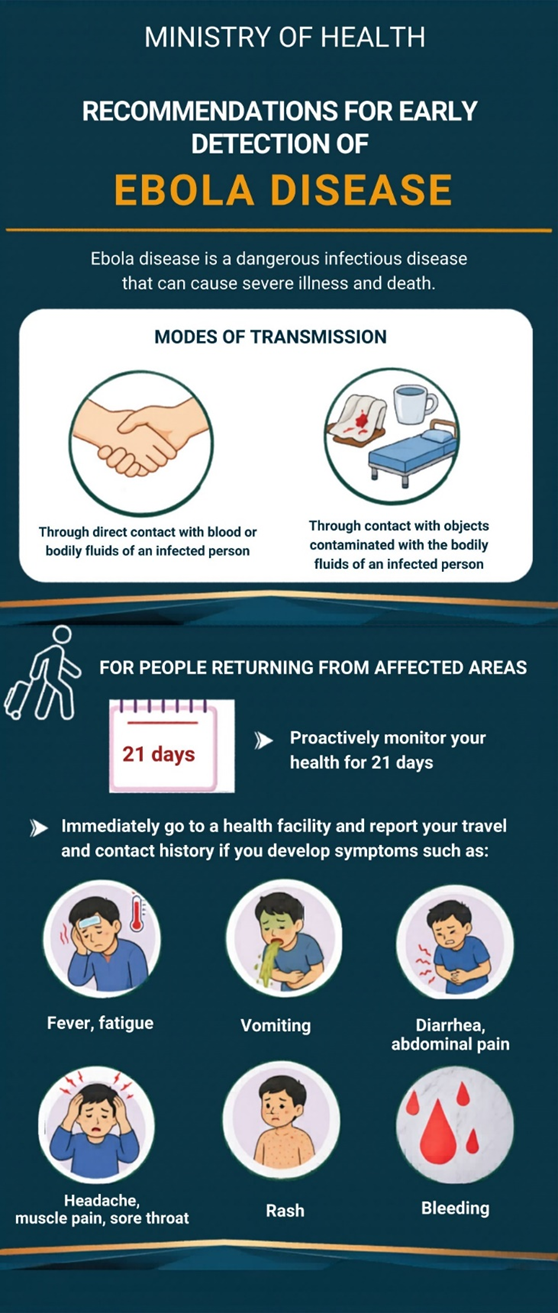
Modes of Transmission
The Ebola virus is transmitted from animals to humans and from human to human through direct contact with:
Blood, bodily fluids, and waste of infected individuals;
Contaminated objects such as clothing, bedding, and needles;
Infected or unknown-origin wild animals.
Early Signs and Symptoms of Ebola
Incubation period: Symptoms typically appear suddenly 2 to 21 days after exposure (commonly 6 to 12 days).
People infected with Ebola may experience:
Sudden high fever;
Headache, muscle pain, and severe fatigue;
Nausea, vomiting, diarrhea, and abdominal pain;
A widespread red maculopapular rash that is not itchy, which may appear between days 5 and 7 of illness;
Hemorrhage (bleeding), such as bleeding gums, gastrointestinal bleeding, or subcutaneous bleeding in severe stages;
Progressive hypotension and shock accompanied by multi-organ failure, often leading to death in the second week of illness;
In some cases, patients may present with meningitis symptoms (altered consciousness, hyperreflexia, myopathy, neck stiffness, unsteady gait, and/or seizures), myocarditis (chest pain, shortness of breath), or uveitis (blurred vision, light sensitivity, blindness).
Diagnosis and Treatment
Ebola is diagnosed by detecting viral RNA sequences using RT-PCR testing in blood or other body fluids.
The main treatment for Ebola involves intensive supportive care and multidisciplinary management.
Antiviral therapies, including monoclonal antibody treatments (mAb) such as REGN-3 and mAb114, as well as Ebola vaccines, have been proven effective but are currently not available in Vietnam.
Strict infection prevention measures must be applied to all patients with symptoms and clear risk factors. These patients should be isolated in separate rooms.
Proactive Prevention – Everyone’s Responsibility
To protect yourself, your family, and the community, follow these preventive measures:
Wash hands frequently with soap or antiseptic solutions;
Avoid close contact with infected or suspected individuals;
Do not come into contact with blood or bodily fluids of infected persons;
Ensure food is thoroughly cooked and water is properly boiled;
Do not use wild animals or animals that died from unknown causes;
Wear masks and maintain personal and environmental hygiene.
After returning from areas with Ebola outbreaks or after contact with suspected Ebola cases, actively monitor your health for 21 days following the last exposure. If fever or other symptoms suggestive of Ebola appear, immediately report to a healthcare facility for timely examination and guidance.
Reference:
- https://www.who.int/emergencies/disease-outbreak-news/item/2026-DON602?utm
- https://www.who.int/emergencies/emergency-events/item/2026-DON605
- https://hcdc.vn/khuyen-cao-phat-hien-som-benh-ebola-04QEdu.html
- https://www.hcdc.vn/benh-ebola-khong-hoang-mang-chu-dong-phong-ngua-de-bao-ve-suc-khoe-s5Bahl.html
--------------------


Our Doctor

Leave a comment